 CMP Slurry PROCESS MATERIALS REFERENCE
Compare systems, not just chemical names
Silica, ceria and alumina are established abrasive classes in CMP literature. Silica appears in metal and dielectric systems; ceria is especially relevant to oxide and STI; alumina is discussed in metal CMP. The formulation and particle engineering determine the practical fit. Abrasive review ↗
| Abrasive system | Particle / surface considerations | Application context | Evaluation priority |
|---|---|---|---|
| Colloidal silica | Controlled dispersed particles; surface charge and chemical treatment affect behavior. | Dielectric and selected metal CMP formulations. | Distribution tail, contamination, film rates and point-of-use stability. |
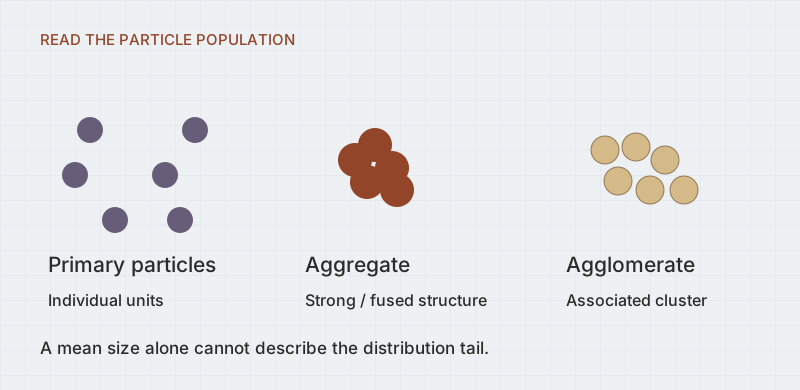
| Fumed silica | Production route yields fused primary structures; aggregate dimensions differ from primary size. Particle-structure overview ↗ | Some dielectric and tungsten products; confirm the actual grade. | Aggregate characterization, handling consistency and defects. |
| Ceria | Chemically active oxide interface; morphology and surface states matter. | Oxide and STI processes. | Oxide removal, stop-film protection, residue and cleaning response. |
| Alumina | Relatively hard abrasive; particle shape and contact load remain critical. | Metal CMP in published and application-specific systems. | Mechanical damage, surface finish, contamination and film selectivity. |
| Composite / modified abrasives | Coatings, dopants or mixed structures can change interfacial behavior. | Research and supplier-specific platforms. | Evidence for the exact film stack and product; no extrapolation from a base oxide. |
What the particle specification should mean
The nominal size may describe a primary particle, an aggregate or an instrument-derived hydrodynamic diameter. Those values are not interchangeable. Require the measurement method, distribution basis, preparation procedure and limits for the large-particle population. A mean that remains stable can conceal a changing tail.
Nano-abrasive literature treats size, shape and surface chemistry as interacting variables rather than independent rankings. Particle-property review ↗
Mechanical and chemical contributions
A harder particle can increase the potential for local mechanical damage, but scratch risk also depends on particle geometry, clusters, film response and contact conditions. Treat relative hardness as context, not a supplier-selection score. The tungsten and dielectric examples in the technical literature illustrate material-specific abrasive behavior. Material-specific abrasive roles ↗
For ceria, a chemically active interface is useful for oxide removal but can complicate residue removal. Published post-STI cleaning work discusses ceria–silica bonding as part of that challenge. Ceria cleaning research ↗
Design an abrasive comparison that can be interpreted
- Identify whether the question is abrasive family, product substitution or process optimization. Do not confound all three.
- Record solids content, point-of-use preparation, pad, conditioning and exposure time.
- Use the same film lots and metrology definitions across candidates.
- Measure rate and uniformity, then classify defects instead of comparing only total counts.
- Check residue after the intended clean; include queue and hold conditions.
- Compare fresh and aged point-of-use material within each supplier’s documented use-life.
A colloidal-versus-fumed silica comparison deserves a dedicated page only when a specific application and enough comparable evidence are available. Here, the distinction remains in this guide rather than becoming a thin standalone article.
Sources & evidence
- Abrasive Materials for Semiconductor Chemical Mechanical Polishing ↗Peer-reviewed review · ACS Applied Materials & Interfaces · 2026. Silica, alumina, ceria and composite abrasives. Public abstract reviewed; access to full text may vary.
- A Comprehensive Review of the Nano-Abrasives Key Parameters Influencing Performance in CMP ↗Peer-reviewed review · Nanomaterials · 2025. Particle size, morphology, surface chemistry and ceria–silica interactions. Publisher page rate-limited during direct retrieval; indexed publisher excerpts reviewed.
- Abrasive for Chemical Mechanical Polishing ↗Technical chapter · IntechOpen · 2018. Abrasive roles in metal and dielectric CMP, including tungsten surface oxidation. Historical application statements should not be read as current market facts.
- Effect of complexing agent on ceria particle removal in post-STI CMP cleaning ↗Peer-reviewed research · Colloids and Surfaces A · 2023. Ceria–oxide bonding and particle-removal challenges; public abstract reviewed.
- Evonik — Technical Overview: AEROSIL Fumed Silica ↗Abrasive-material manufacturer technical overview. Primary particle, aggregate and agglomerate distinctions for fumed silica. Indexed technical excerpts reviewed; the PDF exceeded direct retrieval size limits. This is particle-structure context, not a CMP product recommendation or preparation procedure.