 CMP Slurry PROCESS MATERIALS REFERENCE
What distinguishes STI from general oxide CMP?
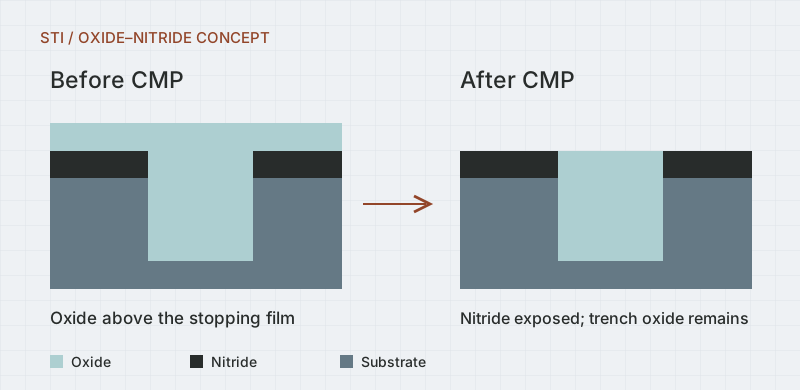
In a typical oxide/nitride STI context, oxide overburden is removed over patterned isolation structures and nitride acts as a stopping film. The practical question is whether oxide clears across the relevant pattern range without unacceptable stop loss or isolation-height change. General oxide planarization need not have that same stopping requirement.
AGC explicitly lists CES-300 / 330F series ceria slurry for STI and ILD applications. A supplier application category establishes participation, not qualification on the buyer’s patterned stack. STI manufacturer source ↗
Selectivity and stopping behavior
Oxide-to-nitride selectivity compares removal rates under stated conditions. Stopping behavior is the process response as nitride becomes exposed and contact changes. A high blanket-film ratio does not by itself guarantee uniform stopping across dense and sparse patterns.
| Response | Question for a trial | Why blanket rate is insufficient |
|---|---|---|
| Oxide clearing | Does residual field oxide remain at any representative location? | Average rate does not show local endpoint. |
| Nitride loss | How much stop film is lost at early-clearing regions? | Exposure time and pattern contact differ. |
| Isolation oxide height | What changes with pattern size, density and overpolish? | Retained oxide can continue to change after field clearing. |
| Uniformity | Are center, edge and pattern families within the agreed limits? | One ratio hides wafer-position dependence. |
| Defects after cleaning | Which particle residues or scratches remain? | Planarity does not demonstrate surface cleanliness. |
Ceria, additives and dispersion
Published STI work on poly(acrylic acid)-containing ceria slurries investigates colloidal stability, planarization and selectivity together. It illustrates that additives can affect more than the stop-film rate; the reported formulation is an experimental system, not a generic production recipe. STI polymer study ↗
For a candidate product, ask which material is responsible for the stated stopping behavior only to the extent the supplier can disclose it. The qualification should rely on observable performance, not an inferred proprietary mechanism.
Ceria residue removal needs explicit attention because published studies describe strong interaction with oxide. Evaluate the intended clean and the queue into it rather than measuring particles only immediately after polish. Ceria residue study ↗
Write an STI-specific requirement set
- Name oxide deposition, nitride film and any other exposed layer.
- Specify pattern families and the locations used for clearing and height assessment.
- Define nitride-loss and retained-oxide-height acceptance separately.
- State endpoint and allowable overpolish behavior as test conditions.
- Require particle and defect results after the intended cleaning sequence.
- Define the point-of-use preparation, aging and storage interval used in each trial.
Advance candidates only when rate, stopping response, patterned topography and surface quality satisfy the same agreed window. If a supplier shows impressive nitride selectivity, ask for the corresponding patterned results and their test conditions before interpreting it as a process solution.
Sources & evidence
- Poly(acrylic acid)-Containing Ceria Slurries for STI CMP ↗Peer-reviewed research · Polymers · 2026. Dispersion, planarization and oxide-to-nitride selectivity in a particular experimental system. Indexed publisher excerpts reviewed.
- AGC — CMP Slurry ↗Manufacturer primary source. CES-300 / 330F series ceria slurries for STI and ILD; listed sales regions are not proof of redundant manufacturing.
- Effect of complexing agent on ceria particle removal in post-STI CMP cleaning ↗Peer-reviewed research · Colloids and Surfaces A · 2023. Ceria–oxide bonding and particle-removal challenges; public abstract reviewed.
- Strategies for Enhancing SiO₂ CMP: Functional Nanoparticle Abrasive Design ↗Peer-reviewed review · Chemistry — A European Journal · 2025/2026. Publisher abstract indexed by PubMed: ceria and nonceria abrasive design for oxide CMP.