 CMP Slurry PROCESS MATERIALS REFERENCE
Removal is only part of the job
CMP means Chemical Mechanical Planarization or Chemical Mechanical Polishing. “Planarization” emphasizes reducing topography; “polishing” describes the removal process. A wafer can lose material without becoming sufficiently planar, so the two outcomes should be evaluated separately.
A slurry helps create a surface that can be removed under controlled contact with the pad and abrasives. Performance depends on chemical and mechanical actions together, including the tool and pad conditions. It cannot be assigned to the liquid alone. CMP fundamentals ↗
- Remove the intended overburden or film at a usable rate.
- Limit removal of exposed neighboring or stopping films.
- Reduce height differences across patterned structures.
- Leave a surface that can be cleaned and used in the next process step.
Chemical action + mechanical action
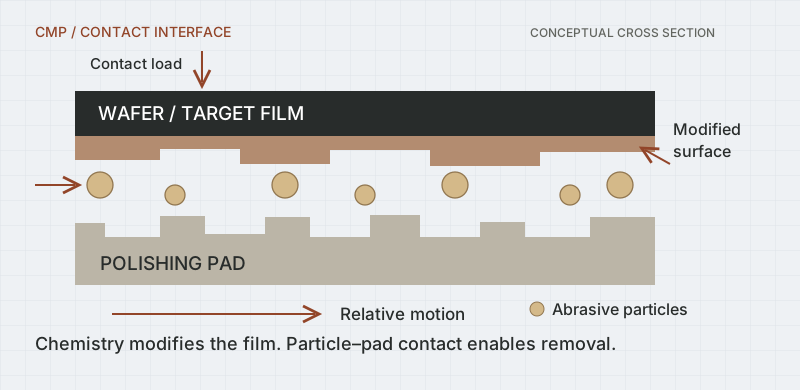
In a metal process, oxidation can modify the surface, complexation can keep dissolved metal species in solution, and inhibition or passivation can restrict unwanted attack. Abrasive contact and pad motion remove or disrupt the surface film. These functions are coupled rather than a mandatory sequence shared by every slurry. Copper mechanism research ↗
| Function | Engineering meaning | What to establish |
|---|---|---|
| Surface modification | Change the exposed material’s response to contact. | Which film forms, and is it protective, removable or both? |
| Oxidation / dissolution | Convert or transfer material into chemically altered or dissolved species. | How much removal occurs without polishing? |
| Passivation / inhibition | Suppress surface attack under some conditions. | Does protection remain effective in recesses and during idle time? |
| Complexation | Bind dissolved metal ions and alter solution equilibria. | Does the chemistry increase removal, corrosion or cleaning burden? |
| Mechanical action | Transfer load through pad asperities and particles. | Does the combination meet planarity and defect requirements? |
Why CMP is more than abrasive polishing
An abrasive-only explanation misses both surface chemistry and selectivity. A chemical-only explanation misses why elevated regions can be removed differently from recessed ones. The contact interface brings these effects together; its behavior changes with film properties, pad texture, lubrication and operating conditions. Wafer-interface review ↗
Why formulation varies by application
Copper, tungsten and silicon dioxide present different surfaces and integration constraints. Even two products intended for copper can serve different stages: rapid overburden removal, clearing to a barrier, or a later buff. The adjacent film, geometry and cleaning sequence matter as much as the target-material name.
A useful starting description is therefore “target / adjacent film / process stage / acceptance criteria.” “Slurry for semiconductor polishing” is too broad to support a meaningful comparison.
- Name every exposed film, including liners and stopping layers.
- State whether development concerns rate, planarity, defects or a combination.
- Separate measured results from supplier specifications and research demonstrations.
- Carry the pad, tool, endpoint and cleaning conditions with every performance comparison.
From understanding to selection
Read the functional component guide to interpret product documentation, then use a material guide to define risks. The performance framework turns those risks into tests. A supplier shortlist follows from the requirements; it should not define them.
A promising laboratory result is a reason to investigate, not evidence that a formulation will qualify on a different wafer stack. Start with controlled screens and advance candidates through the actual process platform.
Sources & evidence
- Zhao & Lu — Chemical mechanical polishing: Theory and experiment ↗Peer-reviewed review · Friction · 2013. Chemical–mechanical synergy and the roles of the carrier, pad, slurry and operating conditions.
- Seo — Chemical and mechanical phenomena at the wafer interface ↗Peer-reviewed review · Journal of Materials Research · 2021. Contact mechanics, lubrication, electrochemistry, adsorption and limits of simple removal models.
- Chemical processes in the chemical mechanical polishing of copper ↗Peer-reviewed research · Materials Chemistry and Physics · 1995. Early experimental examination of copper removal and planarization mechanisms. Public abstract reviewed.