 CMP Slurry PROCESS MATERIALS REFERENCE
Build an evidence register, not a yes/no questionnaire
For each requirement, record the supplier response, supporting document, revision, date, owner and unresolved gap. Classify evidence as supplied, reviewed, demonstrated or outstanding. “We have quality controls” is not equivalent to a controlled specification or a sample COA.
The questions below are buyer-side recommendations. They are not assertions about any listed supplier and are not an industry certification scheme. Apply them proportionately to development samples, qualification purchases and production supply.
Download the supplier qualification checklist CSV ↓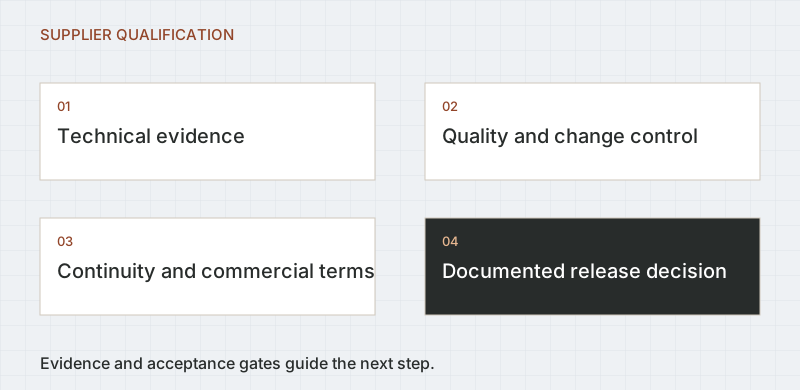
Technical: consistency and application support
| Ask for | Review for | Unresolved risk |
|---|---|---|
| Exact grade, revision and candidate-film scope | Clear product identity and which process evidence applies. | A family brochure being treated as grade-level support. |
| Particle distribution and large-particle methods | Limits, method, sample preparation and uncertainty. | A stable mean hiding a changed distribution tail. |
| Relevant impurity specifications | Defined contaminants, limits and analytical methods. | Generic “high purity” language without applicable control. |
| Lot-to-lot process evidence | Comparable protocol and enough lot history for the release scope. | A single development sample representing production supply. |
| Prepared-state stability data | Dilution / activation, aging, hold and delivery conditions. | Supplied-state shelf life substituting for point-of-use use-life. |
| Qualification support plan | Named technical route, response expectations and failure-analysis capability. | Trials or excursions without timely root-cause support. |
Request enough information to control the product without demanding that proprietary formulas be published. If an ingredient remains confidential, define measurable release attributes and change notification sufficient to protect the qualified process.
Quality: the release system behind the container
- Obtain the controlled specification and a representative COA. Identify which attributes are measured for every lot versus periodically.
- Require lot identity to connect the shipment, container, COA, manufacturing records and retained samples.
- Clarify test methods, specification limits, measurement capability and disposition authority.
- Review manufacturing and contamination-control practices relevant to the product, using documented evidence or an appropriate audit.
- Ask how out-of-specification or out-of-trend results are investigated and whether statistical monitoring is used for critical attributes.
- Define the process for complaints, containment, retained-sample analysis, corrective action and effectiveness checks.
- Determine how subcontracted production, testing or packaging is controlled.
Change control: protect what was qualified
Agree notification and assessment requirements in writing. Do not invent a universal notice period; determine a commercially workable period that gives the buyer time to evaluate process impact. The agreement should distinguish a proposed change, an emergency change and a discontinuation.
| Change type | Information to request | Buyer decision |
|---|---|---|
| Formulation / additive / abrasive | Reason, affected product, comparison data, timing and retained reference material. | Which wafer tests are required before acceptance? |
| Raw material / sub-supplier | Scope, controls and evidence of equivalence or changed impurity/particle profile. | Does the qualified risk assessment remain valid? |
| Manufacturing process / equipment | Affected site or line, validation and release comparison. | Is a qualification bridge sufficient? |
| Specification / method | Old/new limits or methods and correlation data. | Can results remain comparable and meaningful? |
| Site / packaging / logistics | Origin, container and transport changes, validation and timing. | Do handling, contamination and continuity controls remain valid? |
| Discontinuation | Last-order, last-shipment and alternative-product information. | How will a replacement be qualified before supply ends? |
Define whether notification alone is sufficient or whether buyer review / acceptance is required for particular changes. Include the cost allocation and technical support for supplier-driven requalification in the commercial discussion.
Supply chain: distinguish possible backup from qualified backup
A second company site or a global sales network does not establish redundant supply for the selected grade. Ask where the product is actually made and released, which site can produce the same grade, and whether transfer data exist. A backup needs the relevant quality and wafer acceptance evidence.
- Manufacturing and release sites, with the selling entity identified.
- Critical raw-material dependencies and sole-source exposure, to the extent shareable.
- Capacity availability against the buyer’s forecast and the assumptions behind lead time.
- Packaging, transport constraints, delivery frequency and shelf life remaining at receipt.
- Disaster recovery, business continuity, allocation policy and communication path.
- Qualified alternate site or product, including the status of bridging work.
- Inventory responsibilities, forecast commitments and expiry-risk allocation.
Commercial: compare quotes on the same basis
Define supplied concentration, point-of-use assumptions, minimum order, qualification quantities and sample policy. Clarify volume tiers, forecast commitments, freight, packaging charges, payment terms and price review or protection. Separate a development price from a production arrangement.
Ask what happens if a product arrives with less than the agreed remaining shelf life, a damaged package or an incorrect COA. Write the acceptance and claim process so procurement, quality and operations use the same rule.
Contractual: make exceptions and remedies explicit
- Written product specifications and which revision governs the order.
- Lot traceability and access to the agreed release documentation.
- Change notification and acceptance requirements for the defined change classes.
- Discontinuation notice and continuity commitments where negotiated.
- Definition of nonconforming product and the claim / investigation procedure.
- Replacement, credit or other agreed remedies and timing.
- Root-cause support and handling of suspect stock, retained samples and affected lots.
- Audit and documentation access appropriate to the supply relationship.
- Allocation of requalification work and costs after supplier-driven changes.
- Escalation contacts and decision rights for an urgent excursion.
These are negotiation topics, not statements of legal entitlement. Convert the agreed decisions into the actual supply documents with the buyer’s purchasing, quality and contract owners.
Qualification decision and requalification triggers
Use explicit release states: candidate, trial approved, technical qualification complete, supply approved, or rejected / deferred. Record exceptions, their owners and closure dates. Approval should name the product, site, preparation and process scope it covers.
A significant product/site change, recurring nonconformance, process-stack change or new backup path can trigger a reassessment. Keep the baseline data and reference samples available so the team can assess change against what it originally approved.