 CMP Slurry PROCESS MATERIALS REFERENCE
CMP slurry
A process liquid, usually containing dispersed abrasive particles and chemical additives, used with a polishing pad to remove material and planarize wafer surfaces.
Chemical Mechanical Planarization / Polishing · Chemistry, performance and sourcing for semiconductor manufacturing. Read the fundamentals →
At the wafer–pad interface
PROCESS CROSS-SECTION / CONCEPTUAL, NOT TO SCALE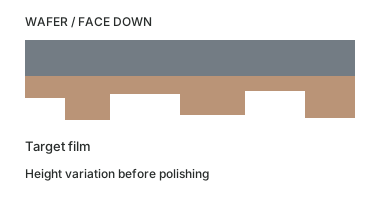
Target film varies in height across the wafer surface.
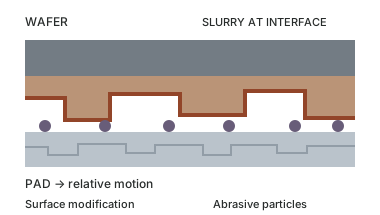
Slurry chemistry modifies the surface; abrasive contact and pad motion enable removal.
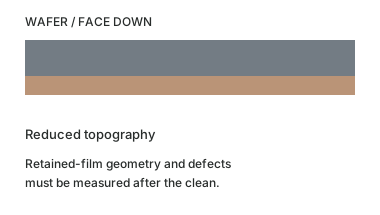
Reduced topography is the objective. Film balance and defects still require measurement.
Wafer shown face down. The illustrated surface is a generic target film; behavior depends on material, formulation, pad, operating conditions and clean. Evidence and further reading →
Select the material. Define what must remain.
Target chemistry and neighboring films determine the questions that matter.
| Target | Common film / process context | Primary challenge | Technical guidance |
|---|---|---|---|
| Cu | Copper interconnect overburden | Balance removal with corrosion protection | Open process dossier → |
| W | Tungsten overburden | Clear fields while limiting feature recess | Open process dossier → |
| SiO₂ | Silicon oxide / dielectric films | Film-specific removal and surface quality | Open process dossier → |
| STI | Trench-fill oxide over nitride | Clear oxide overburden while preserving stop film | Open process dossier → |
| Ta / TaN | Barrier with exposed Cu and dielectric | Control simultaneous response of exposed films | Open process dossier → |
Inside the slurry
Chemical functions and dispersed particles form a coupled process liquid.
Component functions and tradeoffs →Functional map, not a recipe. Roles can overlap; not every slurry contains every component.
Engineering question index
- 01Why does abrasive chemistry matter? Particle / surface interaction
- 02What does a selectivity ratio establish? Film rates and matched conditions
- 03Where do scratches and residues come from? Defect mechanism and evidence
- 04How does pH change the process? Chemical state and compatibility
- 05How do copper and tungsten differ? Target chemistry and feature loss
- 06What must repeat before release? Lots, tools and operating window
- 07Which manufacturers disclose relevant products? Primary-source participation
- 08What belongs in a usable RFQ? Requirements, evidence and supply terms
A procurement path grounded in process evidence
A disclosed product family is a research starting point. Qualification establishes suitability for a defined process.
Read claims in context.
Published findings, manufacturer disclosures and buyer recommendations support different decisions. This independent reference provides no proprietary recipes or guaranteed process settings.