 CMP Slurry PROCESS MATERIALS REFERENCE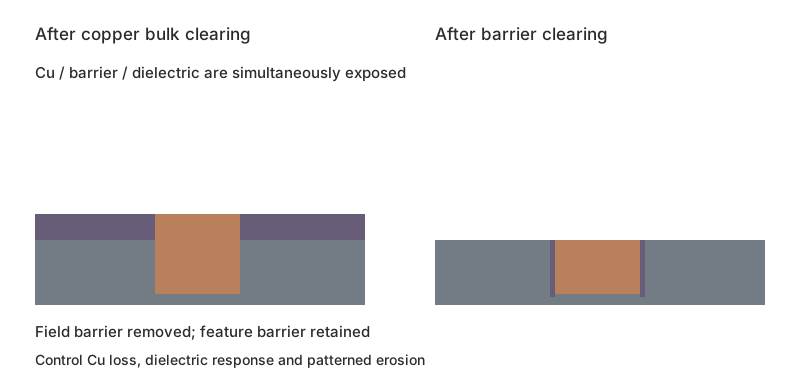
The step after copper clearing has a different job
Copper barrier processes can expose copper features, barrier films such as tantalum or tantalum nitride, and dielectric in the same polish. Name the exact stack: “barrier” describes a function, not a single material.
FUJIFILM describes its barrier slurries as removing exposed barrier metals following copper clearing and planarizing the film surface. Qnity describes configurable selectivity for barrier and TSV applications. These supplier descriptions demonstrate why a universal barrier ratio would be misleading. Barrier application ↗ Selectable film balance ↗
Build a film-rate map
| Film / response | What to establish | Failure if ignored |
|---|---|---|
| Barrier or liner | Rate and field clearing for the actual deposited film. | Residual conductive film or incomplete clearing. |
| Copper or other retained metal | Polishing rate, static loss and feature-height response. | Dishing, recess or corrosion. |
| Dielectric | Removal and mechanical response of the actual dielectric. | Erosion or damage to surrounding insulation. |
| Interfaces | Response when films are electrically coupled and jointly exposed. | Localized attack absent from isolated-film screens. |
| Post-clean surface | Residue, roughness and contamination after the full sequence. | A clean-looking as-polished surface that fails downstream. |
Keep the individual rates alongside any reported ratios. Two products can have the same barrier-to-copper ratio but different absolute rates, clearing times and total film loss. Endpoint and exposure history determine which difference matters.
Patterned topography is the acceptance test
Pattern-dependent copper CMP models distinguish bulk removal, barrier removal and overpolish. The resulting dishing and erosion reflect stage and layout rather than a single material-rate number. Pattern and stage dependence ↗
Use representative line widths and densities. Track early-clearing and late-clearing locations, then measure retained-metal height and dielectric loss. Evaluate the nominal endpoint and an agreed extension to establish whether the process has sufficient margin.
Corrosion, defects and cleaning
When dissimilar metals are involved, request evidence for the exposed pair. Recent copper/cobalt work demonstrates material-dependent corrosion inhibition and sliding effects; it should not be extrapolated to tantalum or another liner without testing. Metal-specific corrosion evidence ↗
- Check the transition from bulk slurry to barrier slurry, including any mixing or carryover.
- Confirm whether separate delivery paths, rinses or product-specific filters are needed.
- Classify metal loss and particles separately after cleaning.
- Evaluate the pad and conditioning conditions used for the barrier step.
- Include idle exposure and queue into cleaning in the agreed corrosion screen.
What to ask a barrier slurry supplier
Request the candidate grade, supported target stack and complete multi-film data. Ask whether the product was evaluated as part of a copper-plus-barrier sequence and which clean followed it. A supplier family listing is a starting point for that conversation, not a substitute for product documentation.
In the commercial specification, distinguish supplied-product release attributes from wafer-process acceptance. Agree how a product change that affects rate balance, cleaning or carryover will be notified and requalified.
Sources & evidence
- FUJIFILM Electronic Materials — CMP Slurries ↗Manufacturer primary source. Copper, barrier, cobalt and front-end slurry categories; post-CMP cleaners are separately identified.
- Qnity — CMP Slurries ↗Manufacturer primary source. Stackplane, Novaplane, Optiplane, Acuplane and Klebosol applications; Klebosol trademark attribution is disclosed on the source.
- Corrosion mechanisms of Co and Cu: electrochemistry and triboelectrochemistry ↗Peer-reviewed research · Corrosion Science · 2026. Metal-specific inhibition and the difference between static and sliding conditions. Public abstract reviewed.
- Coverage Layout Design Rules and Insertion Utilities for CMP-Related Processes ↗Peer-reviewed research · Journal of Low Power Electronics and Applications · 2021. Pattern dependence and staged copper polishing. Indexed publisher excerpts reviewed.