 CMP Slurry PROCESS MATERIALS REFERENCE
Primary particles, aggregates and agglomerates
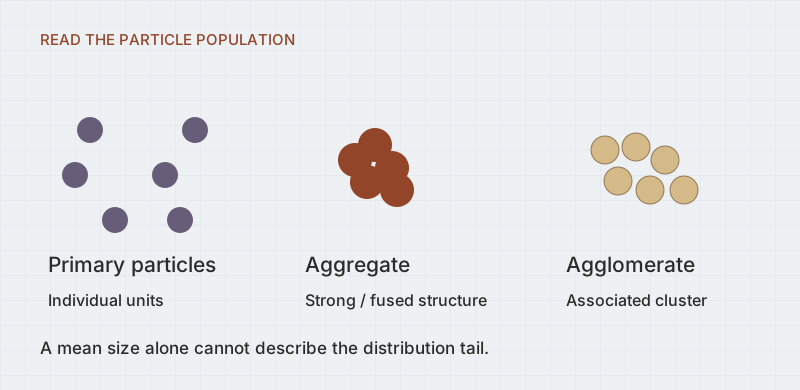
| Term | Working distinction | Question for a product specification |
|---|---|---|
| Primary particle | Individual particle unit identified by the chosen characterization method. | Is the size based on microscopy or another technique? |
| Aggregate | Strongly associated or fused particle structure. | Is this the normal abrasive morphology? |
| Agglomerate | A cluster of associated particles, often more weakly bound. | Does handling change the population, and can it be controlled? |
| Particle-size distribution | Range and population of measured sizes. | Is the result number-, volume- or intensity-weighted? |
| Large particle count | Count above specified size thresholds and conditions. | What are the method, thresholds, sampling point and repeatability? |
Different instruments answer different questions
A hydrodynamic size, an image-based primary dimension and an optical count are different measurements. Require the instrument, dilution and sample preparation, distribution basis and analysis settings. A size value copied without those details cannot reliably establish lot equivalence.
Entegris’s technical material distinguishes mean-distribution characterization from sensitive monitoring of large-particle tails. Treat its instrument descriptions as supplier technical information, not an independent ranking of measurement technologies. Particle-characterization source ↗
Abrasive research also considers particle shape and surface properties. Equal nominal sizes can therefore describe particles with different polishing behavior. Nano-abrasive review ↗
Dispersion stability through the delivery history
Colloidal stability means the suspension remains acceptably distributed under specified conditions and time. Settling, clustering or chemical changes must be evaluated in the supplied state and after approved preparation. A shelf-life statement for a sealed product does not establish stability in a recirculating tank.
Zeta potential can help characterize electrokinetic behavior under stated liquid conditions. It is not a universal pass/fail threshold: steric stabilization, ionic conditions and particle surface treatment also matter. Record pH, medium and preparation with the measurement.
- Establish receiving and storage requirements from the product documentation.
- Keep dilution water, mixing, activation and container cleanliness controlled.
- Track opening, preparation and expiry times independently.
- Check for changes after transfer, pumps, recirculation and idle holds.
- Sample consistently; a tank-top sample may not represent a settling suspension.
A filter is part of the qualification
Filter retention should be tested with the actual slurry, flow and operating history. A nominal rating does not describe every chemistry–filter interaction. Supplier application notes provide examples of examining particle populations before and after CMP filtration. Product-specific filter study ↗
Compare pre/post-filter particle data, differential pressure, throughput and wafer results. Confirm initial filter conditioning, compatibility, replacement criteria and whether useful abrasive or additives are affected. Investigate unexpected size changes rather than assuming finer filtration always improves the outcome.
Translate particle science into buying requirements
Ask for distribution limits and methods, not only a typical mean. Determine which attributes appear on the COA, which are periodically monitored, and which need a buyer-side incoming or point-of-use check. Agree how the supplier investigates an excursion that passes release testing but fails the wafer process.
A meaningful consistency claim includes product lots, containers, measurement uncertainty and the delivery conditions covered. Keep retained samples and traceability so changes can be localized rather than debated from averages.
Sources & evidence
- A Comprehensive Review of the Nano-Abrasives Key Parameters Influencing Performance in CMP ↗Peer-reviewed review · Nanomaterials · 2025. Particle size, morphology, surface chemistry and ceria–silica interactions. Publisher page rate-limited during direct retrieval; indexed publisher excerpts reviewed.
- Entegris — CMP slurry particle characterization ↗Supplier technical information. Large-particle monitoring and filtration characterization; instrument superiority claims are not adopted.
- Entegris — CMP Slurry Filter Testing ↗Supplier application note · 2026. A supplier-specific filtration study. Results do not establish a universal filter rating.
- Chemical Mechanical Polishing: Role of Polymeric Additives and Composite Particles in Slurries ↗Technical book chapter · Elsevier. Functional additives, conventional abrasive classes and suspension stability. Public abstract reviewed; full chapter may require access.